Analysis · the Odyssey and Joyce's Ulysses
Ten Years, One Day
Every factual claim below survived adversarial verification across two research passes (50 claims tested three votes each; 46 confirmed, 4 refuted — the refutations are flagged where they matter). Interpretation is marked as interpretation.
01The scaffold is real — and its architect doubted it
The Homeric skeleton of Ulysses is not a critics' invention. Joyce drew it himself, twice: the Linati schema, a holograph table in Italian sent to Carlo Linati on 21 September 1920 (now Buffalo V.A.1.a, the earliest surviving schema manuscript), which he called a summary–key–skeleton–scheme; and a second schema given to Stuart Gilbert and published, with Joyce's permission, in Gilbert's 1930 study. Episode by episode they assign a Homeric title, an hour, an organ of the body, an art, a color, a symbol, and a narrative technique.
But the same primary record cuts the other way. The Homeric links were elaborated late, in 1920–21, as Joyce finished the book — a device for unifying motifs, not a founding blueprint. He then deleted every Homeric title from the published text, later regretted the schema's circulation as a distraction from the novel's real form, and in 1937 told Vladimir Nabokov the Homeric parallel had been a whim. The scaffolding is simultaneously authorial fact and authorially disowned — which is why the critical war over it has never ended:
The position argued here: both camps are right about different halves of the book, because the parallel does not work by resemblance at all. It works by contrast — the verified thesis of McDonald & McKendrick's comparative study (IFR 16.1, 1989): the differences from Homer are as essential to Joyce's method as the correspondences.
02The map of persons
Joyce's Gilbert schema names some equations outright; others are critical inference from the text. The distinction matters, so the map encodes it: solid lines are schema-attested, dashed lines are inference. What the map cannot help showing is that almost every line, however attested, carries a twist when it lands in Dublin.
Figure 1 · Character correspondence network
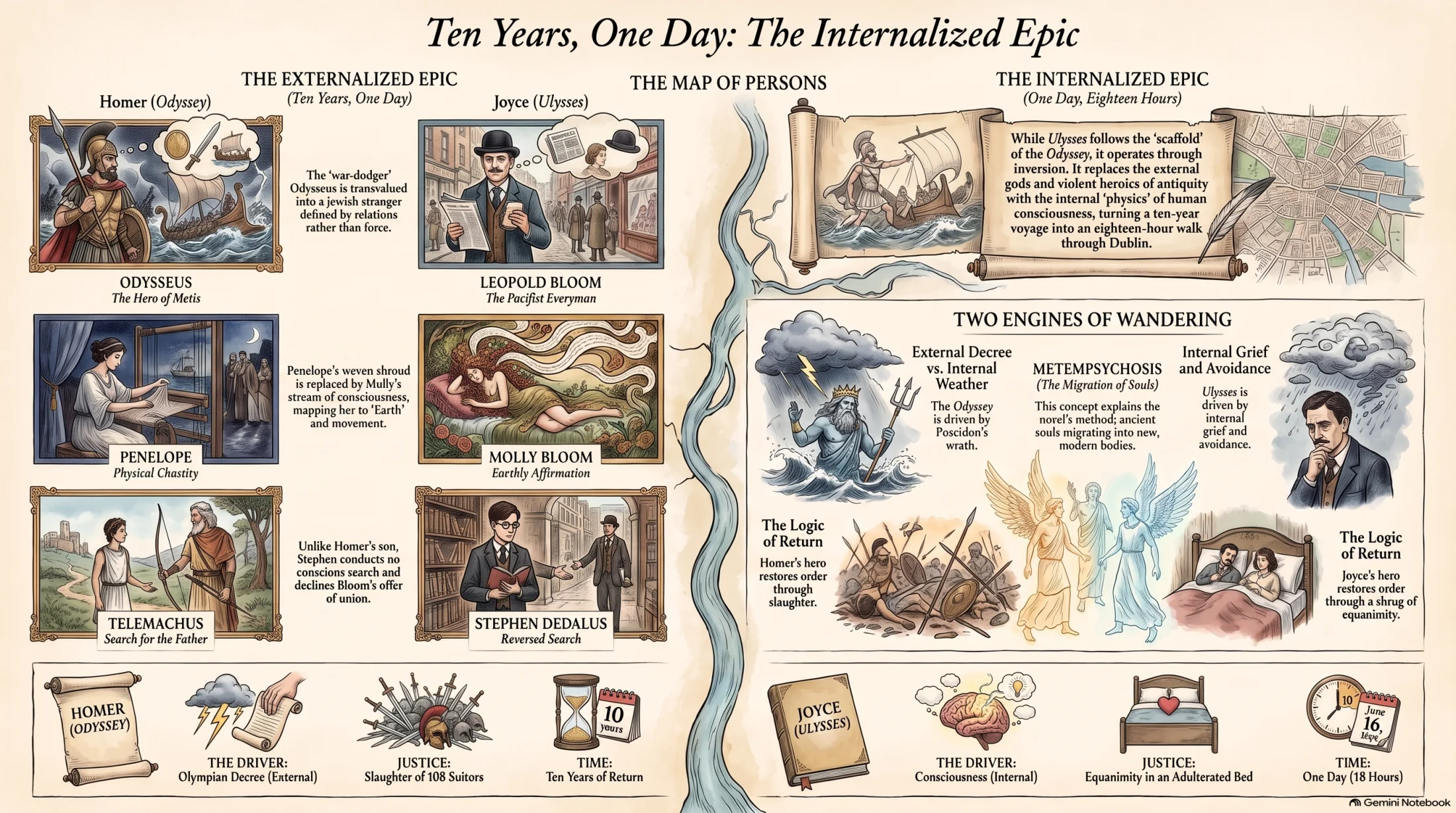
Odysseus → Bloom: the complete man, disarmed
Joyce chose his hero on explicit grounds, recorded by Frank Budgen in Zurich: Odysseus is the only complete all-round character in literature — son to Laertes, father to Telemachus, husband to Penelope, lover of Calypso, companion in arms, king of Ithaca. And Joyce's Homer was already modern: his Odysseus was a war dodger who feigned madness to skip the draft, “the first gentleman in Europe,” an inventor — “the tank is his creation. Wooden horse or iron box — it doesn't matter.” Bloom is that reading incarnated: Jewish in Catholic Dublin as Odysseus was a stranger in every hall, defined by relations rather than by force. Where the correspondence turns ironic is the arsenal: mētis with the violence removed. A 2025 peer-reviewed essay (Torabi, Subject, Action & Society) frames precisely this as the point — the comic, everyday hero set against the epic one is how the book affirms life.
Penelope → Molly: fidelity becomes affirmation
The schema's Penelope entry contains no word about fidelity. It reads: symbol Earth; correspondence Penelope — Earth, Web — Movement; technique monologue (female). Joyce mapped the faithful wife not to faithfulness but to the planet — and described Molly to Budgen as the flesh that always affirms. On the day the novel happens she has consummated adultery with Boylan; her monologue, marked in the Linati schema with ∞ instead of an hour, still closes on the memory of choosing Bloom on Howth Head. Penelope's loom — woven by day, unpicked by night — returns as consciousness itself, weaving one husband till dawn. The inversion is doctrinal: fidelity as chastity kept becomes fidelity as return chosen.
Telemachus → Stephen: the reversed Telemachy
Homer's Telemachy is a divinely sponsored curriculum: Athena arrives in person, the young man travels, learns, returns, and stands beside his father with a spear. Joyce reverses the pattern point by point — Stephen conducts no conscious search for a father, no god sponsors him, and at two in the morning at 7 Eccles Street he declines Bloom's offer to stay, walking out into what “Ithaca” calls the cold of interstellar space. June 16 ends not in union and restored order but in a polite refusal.
03Two engines: the systems view
Read as systems, the two plots are feedback loops with the same topology and different drivers. The Odyssey is driven from outside: an offense against a god's son propagates through divine wrath into ten years of forced wandering, closed by violence that restores the household. Ulysses runs the same loop in one consciousness: grief, not Poseidon, expels the hero from home each morning; equanimity, not slaughter, lets him return.
Figure 2 · Causal loops — what drives each wandering
The psychology of the swap
The formal revolution enabling the second loop is the interior monologue — Homer's hero is rendered from outside, in speech and action; Joyce's from inside the knowing itself, a technique he credited to Édouard Dujardin's 1887 Les Lauriers sont coupés. The cuckoldry plot is where the psychological difference becomes ethical. Odysseus, restored, kills one hundred and eight men (Book XXII). Bloom, entering a bed that carries another man's imprint, runs through envy, jealousy, abnegation, and settles on equanimity — the catechism of “Ithaca” audits his feelings the way the epic audits corpses. The slaughter of the suitors becomes a shrug, and the shrug is arguably the harder feat.
The century's most famous psychologist filed a hostile report and one concession. Jung's 1932 essay found the book tedious and, behind its thousand veils, empty — he admitted falling asleep twice on the way to page 135. Writing to Joyce that September he nevertheless called the Penelope chapter “a string of veritable psychological peaches.” Recent peer-reviewed work argues the hostile half was a misreading: Torabi (2025) shows Jung's verdict was shaped by preconceived expectations, and calls his blindness to the psychoanalytic engagement of the “Circe” episode an almost wilful oversight. The Freudian tradition read the book more attentively earlier: Kimball's “Family Romance and Hero Myth” (JJQ, 1983) treats the paternity theme in Freud's terms, and Shechner's Joyce in Nighttown (1974) gave “Circe” its book-length psychoanalytic inquiry.
04The shared problem: identity through time
If the loops differ in driver, what do the two books actually share? The strongest recent scholarly answer is Stephanie Nelson's Time and Identity in Ulysses and the Odyssey (University Press of Florida, 2022): both works confront the same paradox — a person changes continuously and yet remains, somehow, the same — and both distribute the problem across the same three figures.
Figure 3 · One problem, six solutions
Around that core, the shared motifs line up — and each bends the same way, from ontology toward psychology. Exile and return: a king reclaims his island; an ad canvasser resumes a marriage. Hospitality: both books measure everyone by treatment of the stranger — Homer's monsters are hospitality-violators and his suitors bad guests incarnate; Bloom, who brings the drunk poet home for cocoa, is guest and host at once (the schema names its cabman-shelter chapter after Eumaeus, the swineherd who fed a beggar). Identity and anonymity: Odysseus survives the Cyclops as Noman; Bloom endures the Citizen as the outsider whose nation is questioned to his face, and “Ithaca” finally glosses him Everyman or Noman. One caution our verification insists on: the Bloom–Noman equation is textual and critical, not schema-attested — the claim that Joyce's schema itself maps Bloom to Noman was tested and refuted. Joyce put Noman in the scene; readers put Noman onto Bloom — a perfect miniature of the entire schema debate. Metempsychosis: the book plants its own theory of correspondence in Molly's morning question about a Greek word she reads as “met him pike hoses” — souls migrating into new bodies is what the whole novel does to Homer's cast.
05Divergences, contradictions, and what they mean
Laid side by side, the inversions are not random: every one removes an external guarantee (gods, violence, blood-proof, chastity, a single narrating authority) and replaces it with an internal act (equanimity, memory, choice, affirmation, a reader triangulating). That is the systematic content of Joyce's contrast method.
| Axis | Homer | Joyce | The turn |
|---|---|---|---|
| order | Olympian decree; cosmos integrates the hero | no divine plan; colonized, contingent Dublin | failure itself becomes heroic material |
| justice | slaughter of 108 suitors restores the house | equanimity in an adulterated bed | vengeance → self-command |
| fidelity | Penelope: twenty years, the loom | Molly: adultery at 4, “Yes” at ∞ | chastity kept → return chosen |
| father & son | recognition, then battle side by side | cocoa, conversation, refusal at 2 a.m. | blood proof → provisional communion |
| time | ten years of return | one day; “Penelope” marked ∞ | duration → depth |
| knowing | one Muse-fed omniscient singer | eighteen techniques; parallax named in the text | one truth → triangulation |
| the frame itself | oral epic: formula, performance | schemas written, circulated — then disowned as “whim” | Eliot's order vs Moretti's proliferation: unresolved |
Even the critics repeat the pattern. Eliot needed the parallel to be a governing order; Pound, Moretti, and Nabokov needed it to be scaffolding; Jung needed the book to contain archetypes and, finding consciousness instead, called it empty — and was answered, ninety-three years later, by scholarship arguing the emptiness was in the expectation. The Odyssey ends by restoring one authoritative order. Ulysses — in its text, its schemas, and its whole reception history — refuses to let any single authority close the loop. That refusal, more than any one-to-one correspondence, is its truest reading of Homer: the sea got smaller; the mind got the whole map.
06Appendix: the eighteen stations
The Gilbert schema (1930), published with Joyce's permission — the grid readers navigate by, though no episode title appears in the novel itself.
| # | Episode | Hour | Organ | Technique |
|---|---|---|---|---|
| 1 | Telemachus | 8 a.m. | — | narrative (young) |
| 2 | Nestor | 10 a.m. | — | catechism (personal) |
| 3 | Proteus | 11 a.m. | — | monologue (male) |
| 4 | Calypso | 8 a.m. | kidney | narrative (mature) |
| 5 | Lotus Eaters | 10 a.m. | genitals | narcissism |
| 6 | Hades | 11 a.m. | heart | incubism |
| 7 | Aeolus | 12 noon | lungs | enthymemic |
| 8 | Lestrygonians | 1 p.m. | esophagus | peristaltic |
| 9 | Scylla & Charybdis | 2 p.m. | brain | dialectic |
| 10 | Wandering Rocks | 3 p.m. | blood | labyrinth |
| 11 | Sirens | 4 p.m. | ear | fuga per canonem |
| 12 | Cyclops | 5 p.m. | muscle | gigantism |
| 13 | Nausicaa | 8 p.m. | eye, nose | tumescence, detumescence |
| 14 | Oxen of the Sun | 10 p.m. | womb | embryonic development |
| 15 | Circe | 12 midnight | locomotor apparatus | hallucination |
| 16 | Eumaeus | 1 a.m. | nerves | narrative (old) |
| 17 | Ithaca | 2 a.m. | skeleton | catechism (impersonal) |
| 18 | Penelope | ∞ | flesh | monologue (female) |
07Verification & sources
Two adversarial research passes feed this essay: 2026-08-05 (20 sources, 96 claims extracted, 25 verified: 22 confirmed, 3 refuted — including widely circulated misquotations of Eliot and Jung) and 2026-08-24 (21 sources, 99 claims, 25 verified: 24 confirmed, 1 refuted — the schema-maps-Bloom-to-Noman claim, flagged above).
- Joyce's schemas: Morgan Library exhibition; Buffalo V.A.1.a catalog; Gilbert, James Joyce's Ulysses (1930); the UlyssesGuide collation
- Budgen, James Joyce and the Making of Ulysses (1934; quotes verified against the archive.org scan)
- Eliot, “Ulysses, Order, and Myth,” The Dial (Nov. 1923, public domain); Pound, “Paris Letter,” The Dial (June 1922); Yale Modernism Lab (Domestico on Moretti)
- Jung, “‘Ulysses’: A Monologue” (1932; CW 15) and letter to Joyce, 27 Sept. 1932; Torabi, Subject, Action & Society (2025)
- McDonald & McKendrick, International Fiction Review 16.1 (1989); Nelson, Time and Identity in Ulysses and the Odyssey (UP Florida, 2022)
- Kimball, JJQ 20.2 (1983); Shechner, Joyce in Nighttown (1974)
- The Homeric side cites Butler's translation — readable in full on this site