Analysis · the Odyssey and the New Testament
The Scar and the Wounds
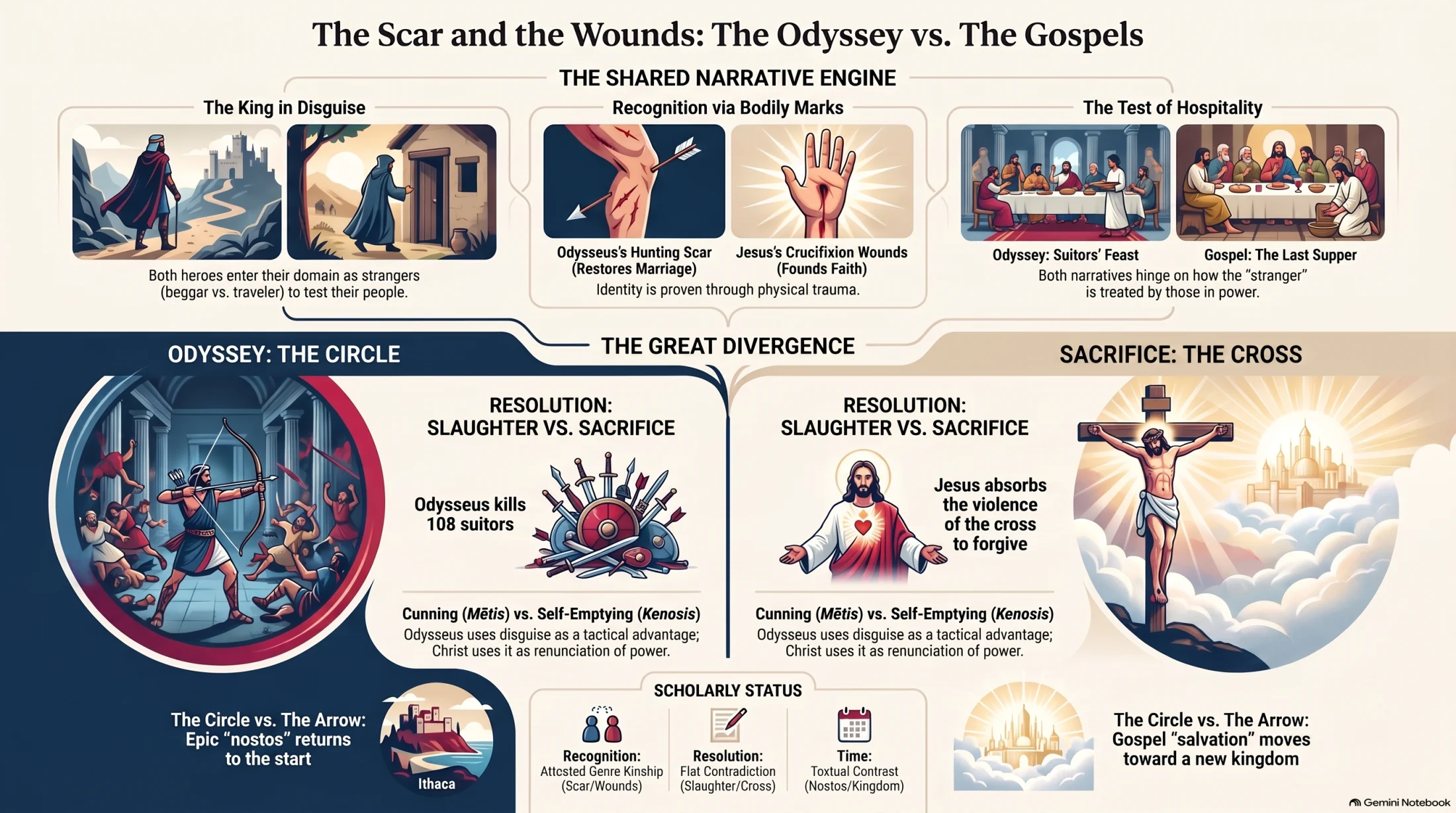
Both stories turn on the same scene: the true king moves unrecognized among his own, is known at last by the marks on his body, and reclaims his house. What each hero does next — slaughter or forgiveness — is where two civilizations part. Every factual claim below survived adversarial verification across two research passes (50 claims tested, 48 confirmed, 2 refuted); interpretation and plain textual comparison are labeled as such.
01The debate: did the Gospels imitate Homer?
Unlike Joyce — who left schemas (see Ten Years, One Day) — no evangelist left a key. So this comparison begins inside a real scholarly war with three camps. The maximalist is Dennis R. MacDonald, whose “mimesis criticism” (The Homeric Epics and the Gospel of Mark, Yale 2000; Does the New Testament Imitate Homer?, Yale 2003; The Gospels and Homer, 2014) claims Mark and Luke–Acts deliberately imitated the epics — modeling Jesus on Homer's heroes so Greek readers would recognize a rival and a successor, with side-by-side scene-types: shipwrecks, cave-dwelling savages, mass feedings, transfigurations, visits from the dead, blind seers. He detects imitation by six criteria — accessibility, analogy, density, order, distinctive traits, interpretability — adding a seventh (ancient readers who noticed) in 2015.
The principal published refutation is Karl Olav Sandnes (JBL 124/4, 2005), and it targets the linchpin, not the individual parallels: genuine ancient emulation of Homer was advertised — Virgil and Lucian signal their models — whereas Mark hides his alleged debt entirely; the more “digested” an imitation, the harder authorial intention is to prove, and a method that counts transformation of the model as evidence explains away its own counter-evidence. Sandnes's positive thesis: MacDonald's parallels are “slippery,” and the intertext Mark actually broadcasts from its first verse is the Old Testament — Isaiah and the Psalms, not the Odyssey.
Between them stands a quieter, better-attested middle: classicists and narrative critics who find genuine Odyssean resonance through shared genre conventions rather than an open scroll — Bruce Louden reading Luke 24 as “in dialog with” the Odyssey's theoxenies; Kasper Bro Larsen reading John through the ancient recognition type-scene; Alexander Thompson tracing Luke 24's recognition to a dual Greek and Jewish genealogy. The argument's structure — and where each attack lands — is a diagram:
Figure 1 · The argument, drawn as a system
02The map of scenes
Because there is no authorial schema here, honesty requires encoding each correspondence's scholarly status, not just its shape. Solid lines: taken seriously well beyond MacDonald (lexical evidence or attested genre kinship). Dashed: MacDonald's claims — documented as claims, contested as imitation. Dotted: shared hero-typology that any two great wanderer-stories would show.
Figure 2 · Scene & person correspondences, by scholarly status
03The psychology of recognition
The strongest genuinely shared structure is anagnorisis — and here recent scholarship gives the comparison real machinery. Bruno Currie's analysis of Book XXIII (JHS 142, 2022) breaks recognition into components ordinarily fused: coming to know an identity, acknowledging it outwardly, and feeling what the relationship demands. Penelope moves through all three in sequence — disbelief, knowledge, acknowledgement, and only then tears — and on Currie's reading the famous bed-test is not an identity check at all but an emotional test: the secret of the immovable bed matters because of what Odysseus's flash of anger proves about the marriage, not what it proves about his fingerprints.
Run the Gospel recognition scenes through that model and the parallels — and one inversion — stand out sharply (textual comparison, ours):
Kasper Bro Larsen's Recognizing the Stranger (Brill, 2008) — the first monograph on recognition scenes in John, whose opening chapter is titled “Odysseus' Scar and Jesus' Wound Marks” — shows John using the ancient type-scene structurally: Jesus as “the divine stranger from heaven,” recognized behind the “half-mask” of a human appearance that simultaneously reveals and conceals. That is the messianic secret rendered in Odyssean stagecraft — and Larsen's mechanism is shared genre convention, not a copy of Homer.
Beneath recognition sits nostos — and its ache. Alexopoulou's study of the return-theme reminds us the very word nostalgia is built from this story: nostos + algos, the suffering of an unappeased yearning to return. The Odyssey is the rare homecoming that ends happily; Greek tragedy's returning heroes (Agamemnon, Orestes) find the homecoming day poisoned — and in the Orestes plays it is the avenger's own act of revenge that leaves him polluted rather than restored. Hold that Greek-internal insight; the next section turns it.
04The wronged king: two solutions to one problem
Strip both stories to their engine and they are the same machine with one part swapped. A rightful king's house is occupied by usurpers — suitors in the hall, money-changers in the Father's house. He arrives disguised, is recognized by a few, tested by many. Then the fork: Odysseus strings the bow and kills every suitor (Book XXII); Jesus, who could summon twelve legions of angels, absorbs the violence instead — and the vindication arrives as resurrection rather than restoration.
Figure 3 · Causal loops — the wronged-king engine, twice
05The philosophical frame
This section is textual comparison and standard scholarship, not workflow-verified claims — the research pass returned no surviving verified claims on these axes, so the texts speak for themselves.
Fate and providence. The Odyssey's sky is crowded and divided — Athena for the hero, Poseidon against, Zeus arbitrating. The New Testament's sky holds one will, and the wanderer's sufferings are not a god's grudge but a providence working through shipwreck (Acts 27's angel in the storm stands where Ino the sea-goddess stood — the scene's furniture is Greek, its theology is not). Mētis and kenosis. Odysseus survives by cunning — disguise as advantage, the lie as art. Christ's concealment is self-emptying: the form of a servant taken, power renounced precisely where Odysseus hoards it. The disguises look identical and mean opposite things. Honor and its inversion. The epic economy runs on honor repaid; the Beatitudes bless the poor, the mourning, the meek — the exact figures the epic pities. The afterlife. Homer's dead are diminished: Achilles' shade would rather be a poor man's servant on earth than king over all the dead (Book XI). Set against that grey Hades, resurrection is not a variation on Greek afterlife hope; it is its refutation. Time. Nostos is a circle — the point of the journey is the point of departure. Salvation history is an arrow — the “return” is to a home the traveler has never seen. Homesickness for a place you have never been is the Gospel's emotional innovation on nostalgia.
06Convergences, divergences, contradictions
| Axis | Odyssey | New Testament | Status |
|---|---|---|---|
| recognition | the scar, the bed — tokens restore a marriage | the wounds, the bread — tokens found a faith, then are transcended | attested genre kinship (Larsen, Thompson) |
| hospitality | xenia under Zeus Xenios; theoxeny tests hosts | agape; the stranger IS the king | attested (Louden); the deepest continuity |
| resolution | slaughter restores the household | the cross absorbs the violence; forgiveness | flat contradiction — the hinge |
| disguise | mētis: concealment as advantage | kenosis: concealment as self-emptying | textual; same device, opposite meaning |
| honor | kleos; shame-culture heroism | the Beatitudes bless what the epic pities | flat contradiction |
| the dead | Hades: better a serf alive than king below | resurrection; death worked backward | flat contradiction |
| home | nostos: a circle back to Ithaca | a kingdom ahead; “no place to lay his head” | textual; circle vs arrow |
| dependence | Did the evangelists copy Homer? Maximalist yes (MacDonald) · minimalist no (Sandnes: the broadcast intertext is the OT) · middle: shared conventions, real resonance | unresolved; middle position best attested | |
07Verification & sources
Two adversarial research passes: 2026-08-05 (21 sources, 85 claims extracted, 25 verified three-votes-each, all confirmed — the MacDonald thesis, criteria, parallels, the Sandnes/Larsson/Winn critiques, the literacy context) and 2026-08-24 (23 sources, 105 claims, 25 verified: 23 confirmed, 2 refuted). The refutations matter: the claim that Sandnes's central JBL critique was about audience education failed 0–3 (his linchpin is advertised emulation; the education argument belongs to his 2009 monograph), and an overstated version of Louden's postponed-recognition claim (that the device exists ONLY in the Odyssey and the Joseph narrative) failed 1–2. Both are excluded above — Figure 2's solid “postponed recognition” edge carries the moderate, Thompson-co-attested version, not the refuted exclusivity claim.
- MacDonald, The Homeric Epics and the Gospel of Mark (Yale 2000); Does the New Testament Imitate Homer? (Yale 2003); The Gospels and Homer (2014)
- Sandnes, “Imitatio Homeri?,” JBL 124/4 (2005); The Challenge of Homer (T&T Clark 2009) · Larsson, JBL 133/2 (2014) · Winn, Mark and the Elijah–Elisha Narrative (2010)
- Louden, “Luke 24, Theoxeny, and Recognition Scenes in the Odyssey” · Larsen, Recognizing the Stranger (Brill 2008) · Thompson, Recognition and the Resurrection Appearances of Luke 24 (De Gruyter 2023)
- Currie, “Recognizing Odysseus, Reading Penelope,” JHS 142 (2022) · Alexopoulou, “Nostos and Death” (2006) · Acts 27 diction: Blass, F. F. Bruce, Praeder
- The Homeric side cites Butler's translation — readable in full on this site