Analysis · the Odyssey and the Aeneid
The Advertised Debt
Elsewhere on this site we ask whether Joyce and the Gospel writers were imitating Homer. Here is the case where the answer is simply yes — openly, famously, and in front of critics who called it theft. It is the control against which every contested claim should be read.
01The charge, and the reply
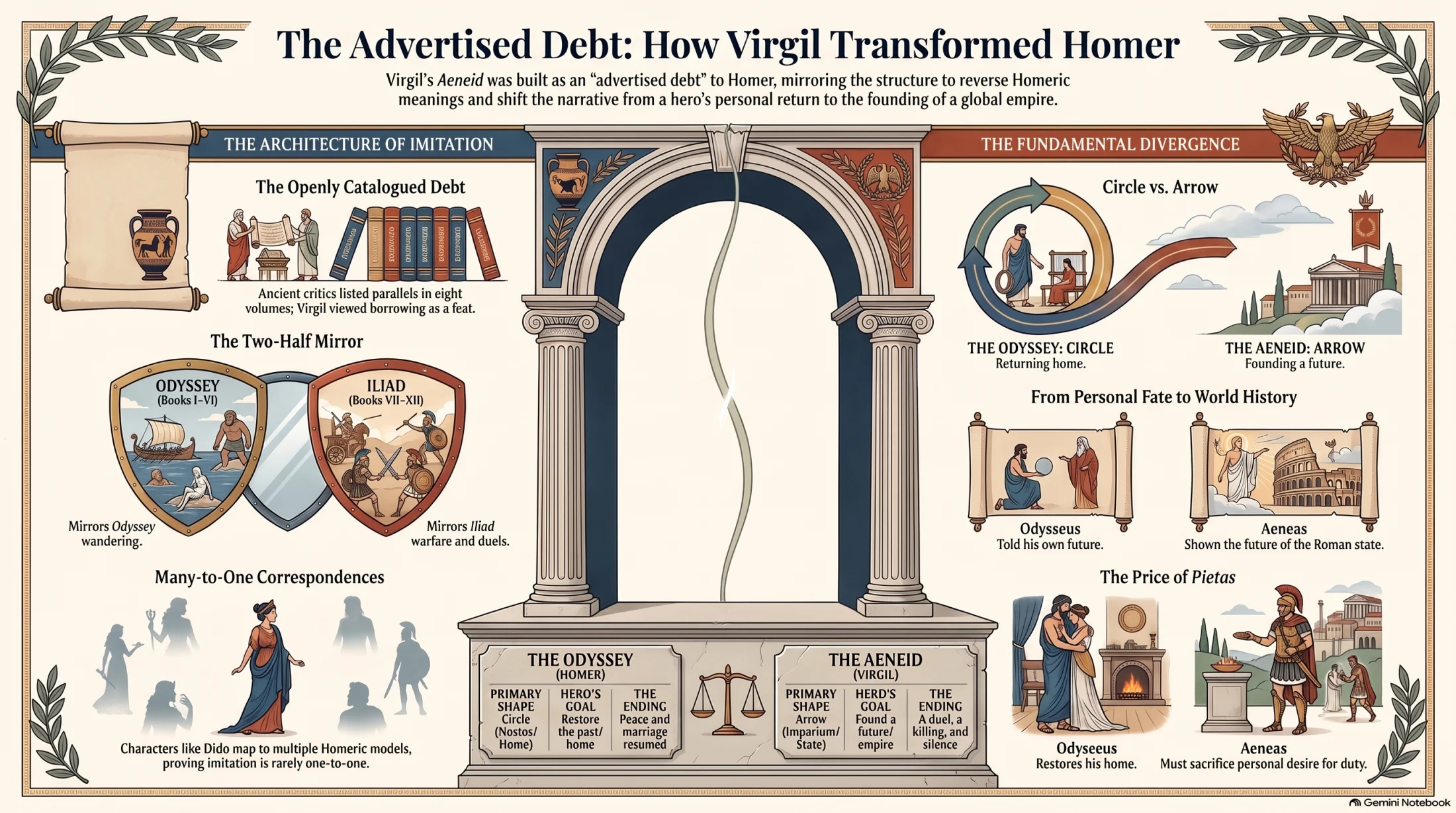
Virgil had organised detractors. The ancient Life of Vergil preserved under Suetonius and Donatus names them: Carvilius Pictor, who wrote a book called Aeneomastix — “Scourge of the Aeneid” — and Quintus Octavius Avitus, who compiled the borrowed verses and their Homeric sources into eight volumes titled Homoeomata, “Resemblances.” An ancient reader, within a generation or two, sat down and listed the parallels. Even Asconius Pedianus, writing in Virgil's defence, conceded that the charges were mostly about how much he had taken from Homer.
Virgil's reported answer does not deny a thing. In Rolfe's public-domain Loeb rendering of the Life:
Why don't my critics also attempt the same thefts? If they do, they will realize that it is easier to filch his club from Hercules than a line from Homer.
That is the whole theory of ancient imitation in one sentence, and it is the opposite of the modern instinct. Borrowing from Homer is not the lazy road; it is the hardest thing a poet can attempt, and what you do with what you take is the achievement. (The Life is a late compilation, so this is what antiquity reported Virgil said rather than a documented utterance — but the detractors and their book titles are the record.)
The comparison then became a genre of its own: Macrobius devotes a book of the Saturnalia to setting Virgil's passages beside their Homeric models and judging between them, and the definitive modern catalogue — Georg Nicolaus Knauer's Die Aeneis und Homer (1964) — is the same exercise done exhaustively. Nobody has ever needed a hidden schema for the Aeneid. The debt was the point.
02Two halves, two models
The architecture is declared. The first six books are a wandering: storm, shipwreck, a royal host, a long flashback told at her table, an underworld. The last six are a war in Italy, with a duel at the end. Servius already read it this way, and it is the first thing any commentary tells you.
Figure 1 · The Aeneid's two halves
03The same scene, pointed the other way
What makes the Aeneid instructive is not that Virgil copies scenes — it is how consistently he reverses their meaning. Three examples carry the whole argument.
The first speech
Both heroes are introduced in a storm, and both open their mouths to wish they had died at Troy. But Odysseus (Book V) is grieving a lost reputation — the honour he would have had if he had fallen where men could see it. Aeneas is grieving something else: dying far from family and city, unburied and unremembered by his own people. Same scene, same posture, different wound — and the difference is the two civilisations in miniature.
The underworld
Odysseus goes down to be told his own future: how to get home, and how he will die. Aeneas goes down and his father stops speaking to him altogether — the great prophecy of Aeneid VI turns and addresses Romane, “Roman”, a person not yet born. The hero of the Aeneid is taken to the land of the dead to be shown somebody else's future. That single grammatical swerve is the difference between a poem about getting home and a poem about founding a state.
Dido, and why clean maps lie
The most useful thing the Aeneid teaches about imitation is that even here — in the case nobody disputes — the correspondences refuse to line up one to one. Dido is the royal host who feeds the stranger and asks for his story (Alcinous and Arete). She is the powerful woman who detains him from his destiny (Calypso, Circe). And when Aeneas meets her again among the dead and she turns away without a word, she is Ajax, who did exactly that to Odysseus in Book XI — a correspondence scholars have traced closely. She is also Medea and, many have argued, Cleopatra.
Keep that in view when reading a tidy table of parallels anywhere else, including on this site. If the undisputed case is many-to-one, a contested case that produces neat pairings should make you more suspicious, not less.
04Nostos and imperium
Strip both to their engines and the shapes differ at the root. The Odyssey is a circle: the goal is the starting point, the reward is the restoration of what already existed, and the poem can end because the man is in his own bed. The Aeneid is an arrow: the goal is a city its hero will not live to see, the reward accrues to strangers a thousand years later, and the poem cannot really end — it stops, mid-quarrel, on a killing.
Figure 2 · Circle and arrow
05The table
| Element | Odyssey | Aeneid | The turn |
|---|---|---|---|
| the debt | the model | announced; catalogued in antiquity in eight volumes | imitation as difficulty, not shortcut |
| hero's desire | to go home | forbidden a home; carries a mission | want → duty (pietas) |
| underworld | told his own future | told Rome's; the speech turns to address a Roman unborn | personal fate → world history |
| the woman who detains | Calypso, Circe — divine, survivable | Dido — mortal, and she dies of it | the cost lands on her, not him |
| the ending | peace imposed; the bed; a marriage resumed | a duel; a killing in rage; then nothing | reconciliation → an unanswered question |
| correspondence shape | Even here, Dido maps to Alcinous/Arete AND Calypso/Circe AND Ajax AND Medea | many-to-one, in the undisputed case | |
06Why this essay exists
Read the other two comparisons on this site against this one. The Gospels are argued about precisely because they show no Virgilian signals: no quotation, no naming, no ancient list of resemblances. Joyce produced the list himself and then deleted the titles from the book. Virgil gives us the third possibility and the only unambiguous one: imitation performed in daylight, defended as the hardest thing in poetry, and transformed so thoroughly that the borrowed scenes end up arguing against their originals.
07Sources
- Suetonius/Donatus, Life of Vergil §43–46, trans. J. C. Rolfe (Loeb, 1914; public domain) — the detractors, the Aeneomastix, the Homoeomata, and Virgil's reply
- Macrobius, Saturnalia book 5 — the ancient side-by-side comparison
- G. N. Knauer, Die Aeneis und Homer (1964) — the definitive modern catalogue of the correspondences
- Scholarship on Dido's many models, including her silence in the underworld read against Ajax in Odyssey XI; on Turnus mapped to Hector and Priam rather than to the suitors
- The Homeric side quotes Butler's public-domain translation, published here in full
Research pass 2026-08-24: 21 claims confirmed against two or more sources, 12 single-source, 7 disputed and flagged in the text. One parallel we went looking for — Turnus as the suitors — could not be sourced and is therefore absent.